A Variable Is a Name Bound to a Value
A variable is a name bound to a value: understand assignment and reassignment so you can trace what a program means at each point.
The common mistake with a variable is to imagine it as a box whose contents are rewritten everywhere its name appears. That picture makes reassignment seem mysterious: changing one line appears to alter earlier code, too. A variable is better understood as a name bound to a value at a particular point in a program.
That distinction helps you read assignments, follow changing state and reason about expressions without treating code as a collection of moving text. The name stays available; the value it refers to can change as the program runs.
What does a variable name refer to?
Consider a simple assignment:
score = 12
In many familiar languages, this means that the name score is associated with the value 12. The equals sign here is an assignment operator, not a claim that two mathematical expressions are permanently identical. The program evaluates the value on the right and binds the name on the left to it.
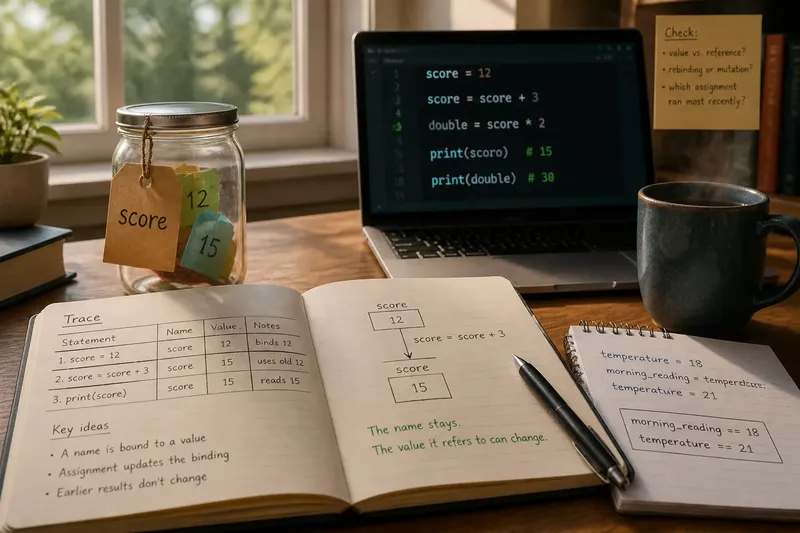
You can think of a name as a label attached to a jar. If the jar is relabelled, a person reading the old label does not find its letters rewritten; they follow the label that is currently attached. The analogy is limited, because languages manage values and names according to specific rules, but it captures the useful idea: a name is how code refers to a value.
In an expression such as score + 3, the program looks up the current value associated with score, then uses that value in the calculation. The text score remains the same. What it refers to depends on the program’s execution at that point.
What changes when you assign a new value?
Suppose the next statement is score = 15. In a language with ordinary reassignment, the name now refers to 15 rather than 12. The earlier assignment still happened, and an expression already evaluated using the earlier value is not retroactively recalculated.
This is why reading code involves keeping track of its order. A line that uses a name sees the binding that applies when that line runs, not some final value that will be assigned later.
Imagine you are reading a small script, starting with temperature = 18. It then calculates morning_reading = temperature and later assigns temperature = 21. If the language copies ordinary numeric values during assignment, morning_reading remains 18 while temperature refers to 21. The visible result is two names with different values; the second assignment has not edited the first statement or its result.
That example describes common behaviour for simple numbers, not every kind of value. In some languages, assigning a name to a list or object copies a reference to the same underlying object. Mutating that object through one reference may then be visible through another. Rebinding one name is still different from changing the shared object itself.
How can you follow a name through a program?
When a variable seems to change unexpectedly, trace its bindings in execution order. For each relevant assignment, note the value or object on the right, then ask what later expressions read. A small table on paper can make the sequence clearer:
- Statement: the assignment or expression being run.
- Name: the variable the statement reads or reassigns.
- Value now: the value the name refers to after the statement.
- Other names: any names that may refer to the same mutable object.
For a basic number, the trace might look like this in words: assign 12 to score; calculate a new value of 15; assign 15 to score. Each line updates the current binding. If the program prints score after the last assignment, it uses 15.
For an expression that combines names, evaluate the right-hand side before considering the new binding. With score = score + 1, the program reads the old value of score, adds one, then binds the name to the result. It is not a circular mathematical statement; assignment describes a sequence of actions.
Debugging tools can help expose that sequence. A debugger’s variable pane shows values at a selected pause point, while a print statement can display a value at a particular line. Compare the value before and after the assignment that matters. This narrows the question to when a binding changes, rather than inviting a search for every occurrence of the name.
Why do earlier uses of a name stay as they were?
Source code is a set of instructions. The written word score in an earlier line is not a stored copy of the variable’s value waiting to be edited. When that line runs, the program resolves the name and evaluates the expression. Once the result has been stored somewhere else, a later reassignment of score does not normally revisit the earlier calculation.
For example, double = score * 2 computes a result using the current value of score, then assigns that result to double. If score is later reassigned, double does not automatically recalculate. To make it change, the program must evaluate a new expression and assign a new value to it, or use a different design that computes the result when needed.
There is an important distinction between a stored result and a deferred calculation. A normal assignment such as double = score * 2 evaluates the right side at that moment in many common languages. A function or expression that is deliberately evaluated later can behave differently because it performs a fresh lookup when called. The code’s meaning depends on that mechanism, not on the spelling of the variable name alone.
What should you check when a variable behaves unexpectedly?
Does assignment copy a value or a reference?
For numbers and other simple values, a new assignment commonly gives the receiving name its own value. With lists, dictionaries and objects, a language may instead copy a reference, so multiple names can point to the same mutable object. Check the language’s rules when a change to a collection appears through more than one name.
Is the object changing, or is the name being rebound?
Rebinding means making a name refer to a different value or object. Mutation means changing an existing object, such as adding an item to a list. Those are distinct operations: a new assignment can leave another name’s binding untouched, while mutation of a shared object can be visible through both names.
Which assignment ran most recently?
Follow the execution path rather than simply looking for the last matching line in the file. Conditions, loops and function calls can mean that some assignments run and others do not. A debugger pause or a carefully placed print statement can show which binding applies at the point where the result is used.
Is the name visible in this part of the code?
Scope describes where a name can be accessed, such as inside a function or across a module. A function may have a local variable with the same spelling as a name outside it; assigning the local one need not rebind the outer name. Keep track of which scope owns each assignment.
How can you practise the idea in one sitting?
Choose a short program in a language you are learning, or write a few plain assignments in a scratch file. Use a number first, then a list, so you can distinguish ordinary reassignment from shared mutable data. Keep the exercise small enough that you can predict each result before running it.
- Assign a number to a clear name, then evaluate an expression that uses it.
- Store the expression’s result under a second name and write down its value.
- Reassign the first name and predict what each name refers to now.
- Run the code and compare the output with your prediction.
- Repeat with a list, assigning it to two names, and inspect the language’s behaviour when the list is mutated.
- Change the exercise so one name is rebound to a new list, then check whether the other name still refers to the original list.
These comparisons build a practical sense of what assignment does in the language you use. The syntax may differ: some languages use a declaration keyword for a new binding, and some distinguish names that may be reassigned from names that may not. Follow the language’s documentation and any relevant instructions for the code you are reading.
The central idea remains useful across those variations: a variable is a name associated with a value, and reassignment changes that association according to the language’s rules. When a result surprises you, trace the name at the exact point of use, and separate a new binding from a change to an object. That habit turns a confusing variable into a sequence of understandable decisions.